
When it comes to chemical processing, distillation, and solvent recovery, choosing the right condenser plays a major role in ensuring efficiency, safety, and purity. Among the many options available, the Glass Shell & Tube Condenser has become one of the most trusted solutions in both the chemical and pharmaceutical industries. Its transparent design, corrosion-resistant properties, and ability to handle demanding processes make it a preferred choice for laboratories and industrial plants alike.
In this blog, we explore the top 10 benefits of using a Glass Shell & Tube Condenser, along with its applications and why Jeshal Glass Works stands out as a reliable partner for high-quality glass process equipment.
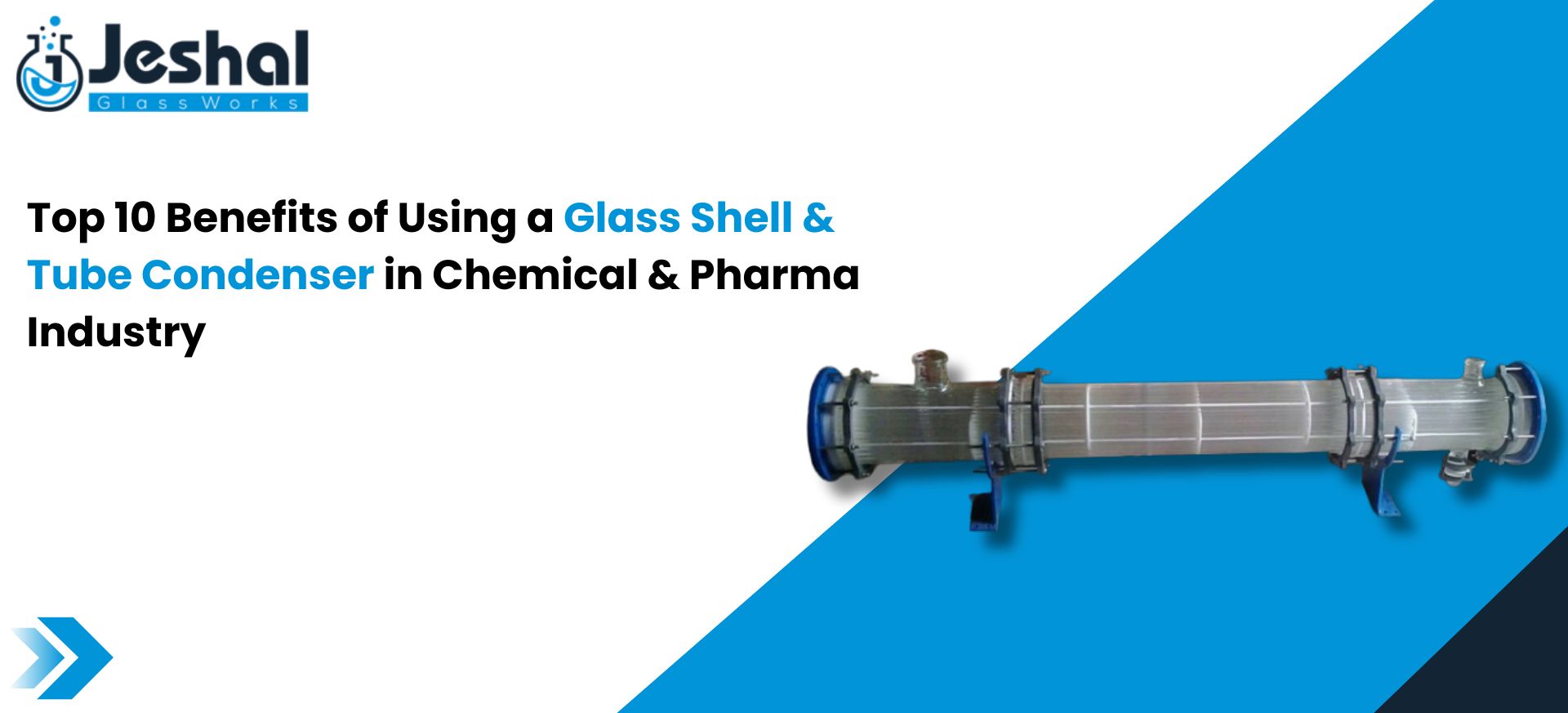
A glass shell & tube condenser consists of multiple glass tubes enclosed in a larger outer shell. Hot vapors pass through the tubes while cooling media (usually water) flows through the shell. The transparency of glass allows operators to visually monitor the condensation process, making it ideal for industries where precision and process visibility are crucial.
These condensers are commonly used in:

One of the biggest reasons industries choose glass condensers is their exceptional resistance to corrosive chemicals. Borosilicate glass, which is used for manufacturing these condensers, is compatible with acids, solvents, and aggressive chemicals that often damage metal equipment. This ensures a longer operational life and safer handling of harsh substances.
Glass shell & tube condensers are designed to withstand sudden temperature fluctuations. Whether switching between hot vapors and cold coolant or running continuous distillation, borosilicate glass maintains structural integrity. This makes it ideal for processes that involve rapid heating and cooling cycles.
Unlike metal condensers, glass provides full visual access to the internal process. Operators can easily monitor:
This transparency leads to better control, quicker troubleshooting, and improved safety during chemical and pharma operations.
Glass does not react with chemicals or release impurities. For pharmaceutical manufacturers and API producers, purity is essential—and glass ensures that no metallic particles or contaminants interfere with the final product. This makes glass condensers perfect for high-purity applications.
Because every part of the condenser is visible, cleaning and maintenance become much simpler. Operators can instantly identify deposits, cracks, or wear on the tubes. This reduces downtime and ensures consistent performance without unexpected breakdowns.
The multi-tube design of a glass shell & tube condenser increases the heat transfer area, allowing vapors to cool more efficiently. This leads to faster condensation, improved productivity, and better performance even at lower coolant temperatures.
Borosilicate glass is known for its durability, strength, and ability to withstand long-term operation under demanding industrial conditions. When paired with PTFE components and reinforced fittings, these condensers offer outstanding longevity and reliability.
Glass shell & tube condensers are suitable for a wide range of temperatures and low to moderate pressure applications. This makes them ideal for:
Their adaptability allows seamless integration into both lab and industrial environments.
These condensers can be customized based on tube diameter, length, and cooling capacity. Whether you need a small laboratory unit or a large industrial condenser, the modular design enables easy scaling and simple installation into existing systems.
Because of their non-reactive and contamination-free nature, glass shell & tube condensers are well-suited for industries where purity and chemical compatibility are critical, including:
Their ability to maintain product integrity makes them a preferred choice across various sectors.
| Feature | Glass Condenser | Metal Condenser |
|---|---|---|
| Chemical Resistance | Excellent | Prone to corrosion |
| Visibility | Full transparency | No visibility |
| Contamination Risk | None | Possible metal leaching |
| Maintenance | Easy to inspect | Requires disassembly |
| Lifespan | Long with proper care | Shorter in corrosive environments |
Glass clearly outperforms metal in processes that involve corrosive chemicals or require high purity.
Glass shell & tube condensers are widely used in:
Their precision, reliability, and clarity make them indispensable for R&D and large-scale manufacturing.
Jeshal Glass Works is a trusted manufacturer and a leading name in high-quality industrial glass equipment. With years of expertise in designing and producing durable, corrosion-resistant, ISO-standard condensers, the company delivers solutions tailored to chemical and pharmaceutical needs. Their products offer exceptional performance, engineered precision, and long service life—making them a dependable choice for process industries.
A Glass Shell & Tube Condenser is an essential component for chemical and pharmaceutical applications that demand purity, chemical resistance, and operational transparency. With benefits like high heat-transfer efficiency, easy maintenance, and long-term durability, it’s clear why industries rely on glass condensers for their critical processes.
For companies looking to upgrade their distillation or heat-transfer systems, choosing a reliable manufacturer like Jeshal Glass Works ensures superior quality and long-lasting performance.
For inquiries or orders, contact us today to get the right condenser for your process needs.
It is used to cool and condense vapors during distillation, solvent recovery, and heat-transfer processes in chemical and pharma industries.
Because it offers high chemical resistance, thermal stability, and ensures contamination-free processing.
Yes, borosilicate glass is strong, corrosion-resistant, and designed to withstand demanding industrial conditions.
Pharmaceutical, chemical, agrochemical, fragrance, and research industries rely on them for purity and process visibility.
Jeshal Glass Works provides ISO-standard, durable, precision-engineered glass condensers trusted by chemical and pharma plants.